


An atmosphere of feeling of anticipation. I can see the cold breath exhaled by my rivals as they perform the "pre-race" wiggle on the start line.
A swift movement of the hips.
I'm lined up for my local Saturday morning race and I'm focused. Three, two, one...
Oh, hang on. I need to adjust my tracker. So does the runner alongside me.
The person behind us expresses impatience. I won't start until… yes! Signal acquired, away I go.
Amidst the crowd, it's challenging to find a person without a smartwatch on it. And this extends beyond us participants who wear them.
This is a thriving, massive sector. Names like Apple Watch lead the market, featuring an wide selection of various versions to cater to a variety of needs. According to how advanced the watch you choose, price tags can vary between £100 to a small fortune.
"I find it infuriating, I'm unable to switch off."
"It reassures me… It's like a friend encouraging me."
"Please don't notify me about a poor sleep."
Just some of the reactions I've received from like-minded smartwatch wearers when I question what they their opinion is on theirs.
The Data Dilemma
My current opinion on mine? Currently, irritating. It's telling me I'm not hitting my target, making me wonder whether the foliage along my route are blocking my GPS connection.
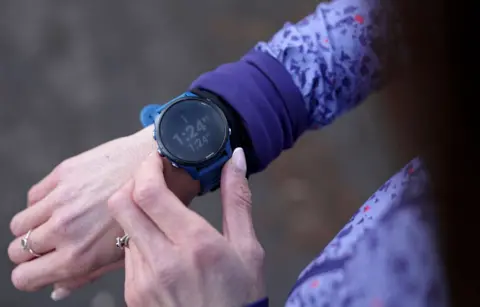
Countless individuals of us fasten these little gadgets onto our wrists and use them constantly, seemingly comfortable with the fact they're continuously monitoring us.
Gone are the days when we relied on them solely to give us an rough count of our daily steps. Now, they can track our sleep patterns, stress levels, glucose levels, our body battery.
It's a challenge to find a physical metric they aren't designed to measure.
But are they able to do what they say they do? And are the numbers we analyse a accurate representation of reality? Do they improve our mental and physical wellbeing, or do the plethora of measurements and constant notifications just add to our daily stresses?

A Complicated Bond
"I do get a bit fixated with mine," a wearer confesses.
While she values how her device monitors her runs, she finds some of its other features "excessive" at times - a feeling first discovered during a pregnancy.
Until she found out she could adjust the settings, her smartwatch constantly alerted her she was being insufficiently productive enough. In a new phase, the watch frequently reports her she's had a restless night.
"I am caring for a infant, it's unnecessary for me to be notified my sleep was poor," she says. "I know that perfectly well."
Is it not possible to just stop wearing it?
"I could, theoretically, but I'm in this complicated dynamic with it," she says. "I value it for its exercise data, but I'm unsure whether the myriad other functions it can now do is maybe overkill for me."
The Technology Behind the Tracking
Each model of smartwatch has its own unique way of monitoring your bodily functions and analysing your data, but the vast bulk use sensors on the reverse of the watch.
They usually shine tiny, coloured LED lights onto your skin which can detect pulsation, detecting your pulse rate. Sophisticated devices analyse changes in the bioimpedance that flows through the skin to gauge your stress levels.
The Professional Viewpoint
A professor says that for most people for smartwatches, it's a "delicate equilibrium" - while the continuously improving tech could potentially save lives, "detecting disease before we show symptoms", it could also turn us the tracked into the "concerned but fine".
He points out that some of the latest wearables can carry out tests like medical-grade monitoring, which regularly monitor how healthy the heart is. They can notify if someone is experiencing a heart arrhythmia, where there is erratic electrical activity in the heart causing an irregular heartbeat.
This does not automatically signal someone is on the verge of a cardiac event, but it can give an advance notice they might be more vulnerable of a blood clot in the future.
But how to understand these figures is complicated. The expert concerns that as additional features are incorporated, people may struggle to fully contextualise their data.
"I'm not entirely convinced that having the capacity to monitor so many things is such a beneficial thing," he says.
A health researcher specialising in wearable tech agrees. Research into the effect of wearable tech on a set of heart condition patients suggested a significant portion of those who were given devices to monitor their cardiac function experienced greater stress and were "had a higher tendency to use doctor's time".
She identified a vicious circle with her patients - they spotted a concerning reading on their watch. They became worried. Their pulse went up. They got even more concerned. They re-examined the data, and their reading went up again.
"Upon viewing numbers about ourselves that we can't properly interpret then, of course, we are going to want to know more," the psychologist says. "We check, we check again - it becomes a feedback loop."


